
By Mel Baiser
You’ve built beautiful homes.
You’ve built happy customers and a solid reputation.
You’ve built a livelihood for your family and your employees through grit, skill, sweat and maybe even a few tears.
You’ve spent the past few decades growing your contracting or design-build business.
So, what happens when you are no longer the person holding it all together?
Most builders don’t intend to close the doors when it's time to retire, but many wait too long to make a plan. They discover too late that the business can’t survive without them in it.
This guide is about building your final project: a resilient construction company that can continue thriving after you hand over the keys. HELM has supported hundreds of construction and design leaders across North America through transitions, big and small. No need to reinvent the wheel. We are here to help.
The Future of Construction
Our industry is facing a major transition.
Residential construction generates over a trillion dollars annually and employs millions of workers, but workforce shortages continue. With 82% of construction firms reporting difficulty filling their skilled trade positions, we still need nearly half a million new workers to meet demand. Meanwhile, young people are not joining the trades fast enough and the average age of a construction worker is forty-two and predicted to be forty-six by 2030.
In the United States, it’s estimated that nearly three million businesses owned by baby boomers are at a transition point. More than half of business closures happen because owners retire. Successful ownership transitions are not only important for your legacy, but they are also critical to the future of this industry.
Want to know how transition-ready your business is? Take our free 5-minute Business Resilience Assessment now.
HELM created this guide because we are passionate about the future of construction and believe stronger businesses create a stronger industry. You need an exit strategy that works for your goals and results in a company ready to thrive without you at the center of it.
Your Exit Options
If you are like most builders, your succession plan may be to continue taking on projects until you can’t. But that isn’t a plan.
Transition-readiness takes time and intention. While the technical ownership transition may happen over 1-2 years, the effort to get your company transition-ready often takes much longer depending on the current state of your business, team, desired ownership model, and access to financing.
Family or sale to a key employee
Do you have a close family member, promising employee, or capable management team in mind for future ownership? This can be a practical way for small businesses to leverage the experience, institutional knowledge, and relationships of those already in the business while rewarding them for their labor and contributions. Good planning and communication are key to all internal sales and particularly when it comes to the complexity of navigating family dynamics.
External Sale
If there is no obvious successor internally, an outside buyer might be an option. Finding the right entrepreneur capable of purchasing, operating, and integrating into an established construction company can be a challenge, which is why a business broker could be supportive if you chose to go with this route.
Employee Ownership
Selling your business to your employees can be an effective and rewarding way to support your exit. There are several paths a business can take that include some form of employee ownership, and each varies when it comes to structure, governance, and financing mechanisms.
Whether you choose to transition to a worker cooperative, where the employees have the opportunity to own and govern the company, an ESOP (Employee Stock Option Plan), a qualified retirement plan which allows for employees to accumulate shares in the company over time, an EOT (Employee Ownership Trust) which holds some or all of the company shares on behalf of employees, or another variation on employee ownership, it will be critical to partner with a specialized advisor.
For example, a common misconception about broad-based employee ownership transitions is that when everyone becomes an owner, everyone becomes a manager. In fact, not all employees have to become owners, but if they do, they elect board members who supervise a general manager. Setting up management and governance structures ahead of time can smooth this – and any - transition.
The focus of this guide is not the transaction itself, but on the critical work leading up to a successful ownership transition. There can be many twists and turns in this journey. What's outlined below is just one of those potential paths. Keep in mind the order of operations may vary depending on numerous factors related to you, your business, and your team.
You can draw confidence from your past experiences. Think of this process the same way you might approach construction: Building business resilience for transition-readiness is much like building a beautiful, high-performing home designed to last.
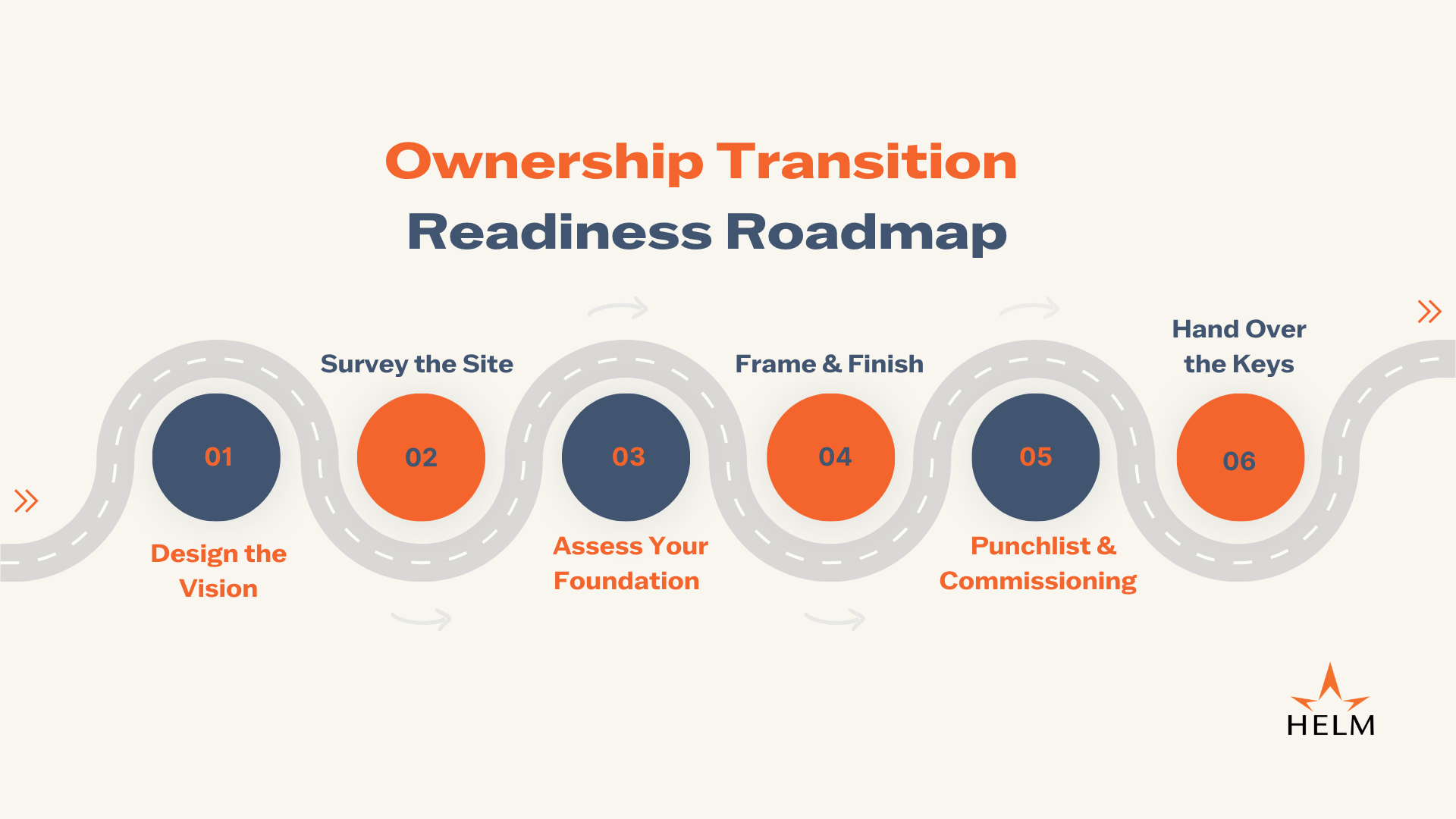
Phase 1: Design the Vision
Every meaningful project begins with a vision. What does retirement look like? Do you have a particular need for a set amount of money or timeline, or is there flexibility? Do you want to stay involved in the business in some capacity moving forward? Is it important to you to receive a payout at one time or are you comfortable with a longer timeframe?
How important is your business legacy to you? Are you committed to maintaining employment for your current team or business for your network of trade partners and vendors?
These questions are practical, but they are also emotional. For many founders, moving on from the business can be like letting go of their identity. If your company is synonymous with and heavily reliant on you, this separation can take time. Even if retirement feels years away, sometimes it’s a decision made for us. Illness or other major life changes can accelerate the timeline abruptly.
This phase is all about research and planning. Explore the various ownership models. Ask around to informally survey other retired business owners. Find out what path they took and if there was anything they wish they had done differently. Begin to build your project team: the trusted advisor(s), legal and accounting counsel, necessary consultants, and motivated employees.
You can think of this phase like pulling together your permit set. You don’t need to have every detail sorted out, but enough clarity to mobilize.
Phase 2: Survey the Site
During this phase you want to take stock of where you are. What is your business worth? What resources do you have and what resources do you need?
You may want to seek a business valuation to get a sense of the “objective” current financial value of your company as a baseline. Valuations can be done informally with an online calculator (proceed with caution), through your local small business center, or via a bank or valuation consultant. Regardless of how you conduct the valuation, know that it can be quite variable and often inconsistent depending on who performs it. Heads up—most sellers feel their business is worth more than a valuation might determine.
You should also evaluate your own capacity. Selling your company will require more work before it requires less. What can you let go of, delegate, or start saying no to create space for this project?
What about your team? Who could become the future owners or leaders? Is there interest? What training or support would be needed? If there is an obvious person outside the company you think could be a potential buyer, now might be a good time to check in with them.
Build your network of trusted advisors early and begin to identify your must haves, dealbreakers, and areas where you are willing to be flexible.
Be intentional about how you communicate transition plans. Sharing too much, too soon can create frustration and resentment, and sharing too late can create uncertainty. Understand your own motivations and intentions first before involving others.
Remember that ownership, leadership, and management transitions do not have to happen simultaneously. Too much change at once can increase risk and overwhelm the team.
Phase 3: Assess Your Foundation
Before building up, it’s important to assess the structural integrity of your core business functions, the literal foundation upon which your entire company is built. Since we are in a climate crisis, let’s reduce the carbon footprint of this building by re-using the existing foundation :). No need to start from scratch. Through this assessment, you can determine what is working well in your business, what needs minor reinforcement, and where shoring may be essential to prevent collapse or irreparable damage.
HELM evaluates business resilience through 5 key areas:
Strategy: Business planning, ownership and governance, and marketing
Finance: Bookkeeping, profitability, budgeting, and compliance
Organization: Workforce development, HR, systems, and culture
Production: Sales, estimating, project management, and construction
Impact: Values, community, and purpose
Most owners know where the pain points are. Employees, collaborators, and clients do too. A survey or series of interviews could provide you with a more comprehensive view of what is working well and what needs attention.
Evaluating your business in such an intentional way can be illuminating and also overwhelming. Running day-to-day operations are taxing, so it is essential to prioritize when tackling business development efforts. You can’t fix everything all at once. Identify your most strategic priorities to focus on first.
Phase 4: Frame and Finish
This is the phase where resilience is built. Every company is unique in its specific strengths and challenges. Some may have a highly skilled and invested team but murky bookkeeping practices that make transparency impractical while others may have dialed in their estimating and project management systems but lack the marketing strategy and leads to keep the crew busy.
Meet your company where it’s at and work from there. Unlike framing a wall, these core areas of your business will never be “complete”, and perfection is not a realistic outcome. Working on your company is a continual cycle of improvement, implementation, and evaluation, but getting the systems and team to a place where they’re better serving the business (and ideally the people, community, and climate) is the goal.
Business resilience is subjective, but from our experience working with hundreds of companies like yours, you are probably on a path to a smooth and successful ownership transition if you are making tangible progress towards achieving these indicators:
Financial stability with reliable annual profitability, working capital saved, and little to no debt; or if there’s debt, you have a clear plan to pay it down. Key stakeholders are financially literate and have access to critical financial reports in the business.
The ability to anticipate and manage workflow and generally avoid being over or under committed.
Sales and rainmaking are not reliant on the owner or on any one person’s shoulders.
Projects are generally completed on time, on budget, to everyone’s satisfaction, and with a minimum of unpleasant surprises.
A functioning, empowered leadership and/or management team is in place, and members of the team have skills that complement the others and can provide checks and balances for each other.
It doesn’t feel ridiculous to float the idea of a sabbatical for the owner in the next 12-18 months.
The business is a source of enjoyment and pride for the current owner. It’s fun to own more often than it’s a pain to own.
There are clear lines of accountability, and everyone follows the same rules, including and especially the owner (most of the time)
As an owner, this phase can entail some of the most difficult work yet. Are you ready to let go, train, delegate, trust, and help develop the next leaders of this business? Ask what the company needs from you now. Remember that “knowledge capture and transfer” is more than documenting what you know and handing it over to someone else to pick up where you left off. A good leader accepts responsibility for developing leadership and capacity in others.
Lastly, are you clear about the specifics of how you will actually transition? Will it be gradual or all at once? Will you continue in the same role or transition to a new role developed just for you? Have you clarified if or how you will participate in the business after ownership has changed hands? Is it documented, shared, and agreed upon by all stakeholders. If you’re not already working with a business coach, these are valuable topics to explore with one.
Phase 5: Punchlist and Commissioning
You are so close. Your business systems are functioning; your team is engaged and now comes testing, documentation, and tying up loose ends.
If you haven’t done it yet, we recommend you plan to take a sabbatical; ideally 3-4 months to test the integrity of the systems you have in place. If the team isn’t ready for you to go, the sabbatical will help you pinpoint the areas that still need attention.
It’s good practice to hand over a completed owner’s manual. Are your systems and processes well documented into SOPs (standard operating procedures) and are the company's templates cleaned up, easy to find, and reflective of the quality and professionalism your business embodies? Do your future owners a favor by completing as much of this as you can while you are still there recognizing that it’s important for the new leaders to also take ownership over the future ways the company operates. While you may have historical knowledge and wisdom from decades of experience, supporting the next owners to integrate this into their own approach will be more empowering than leaving them a manual that only works for the business with you in it.
Whether you are selling the business to an existing employee or group of employees, a family member, an outside buyer, there will be a series of final tasks related to the transition: Another valuation to conduct, financial terms to settle on, legal contracts to draw up and sign, and ribbons to cut.
Phase 6: Hand Over the Keys
Congratulations! You did it. Handing over ownership can bring pride, excitement, grief and relief all at once.
But before you leave, take those finished photos and get your marketing team involved. Letting the community know that the business is in good hands under new ownership is a strategic and important communication. Whether there has been a complete re-brand or just a changing of hands under the original business name, sharing this transition with your trade partners, vendors, clients, and community partners is a great way to minimize surprises and support the business continuity.
Warranty Your Work
You thought you were finished? A quick note about the period after the sale: there are some simple steps you can take to protect your investment and your legacy. You want to ensure the new owners have a good support system in place for their continued business success. Whether it’s setting them up with outside mentors or consultants, or you acting in this role, it can be helpful for them to have additional guidance during this delicate post-transition phase.
A Transition-Ready Business Is a More Resilient Business
Building a transition-ready company doesn’t just make your business more valuable in the future; it makes it more profitable, more efficient, and less stressful to run right now. The work required to get your business transition ready is the same work needed to build a stronger company today.
Your final project isn’t selling the business but building a company strong enough to thrive without you. You will eventually leave your business one way or another. Will your business be ready when you go?
Take the Business Resilience Assessment to find out.